
How to Choose a Cosmetic Raw Material Supplier? Certifications, Patents, and Supply Chain — The Strength of Huatai Bio
Shaanxi Huatai Bio-fine Chemical Co., Ltd. specializes in natural plant extracts and functional cosmetic ingredients. With an integrated pipeline spanning R&D, manufacturing, and quality control, we provide OEM, ODM, and brand clients worldwide with traceable raw material solutions. Below is a technical breakdown of the four dimensions every formulator and procurement manager should evaluate when selecting a cosmetic ingredient supplier.
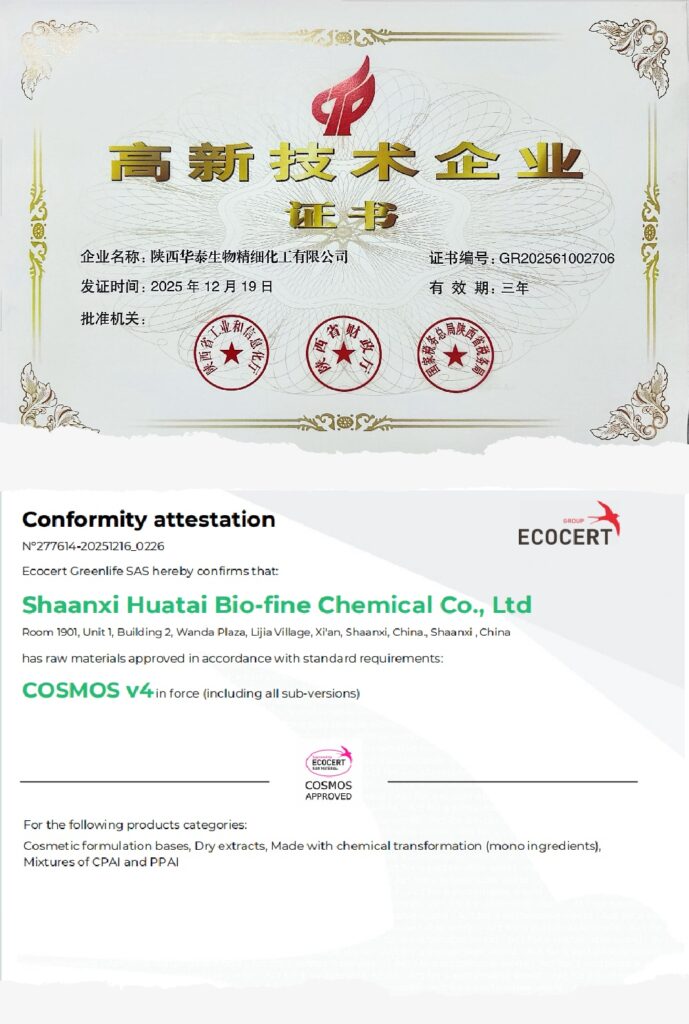
1. Certification Portfolio: Your Passport to Global Markets
In the cosmetic raw material industry, certifications are not “nice-to-haves” — they are prerequisites for entering international supply chains.
ISO 9001:2015 Quality Management System
Audited by China Quality Certification Centre (CQC) in March 2026, our ISO 9001 scope covers the production of food additives (licorice extract powder, mono-potassium glycyrrhizinate, tripotassium glycyrrhizinate) and the sales of plant extracts and cosmetic raw materials. This ensures standardized control across sourcing, production, and release.
ISO 22000:2018 Food Safety Management System
Awarded in February 2026, our ISO 22000 certification covers HACCP principles for food-grade licorice series ingredients. For brands operating across both cosmetics and food sectors, this is the foundational compliance document for cross-category applications.
COSMOS Raw Material Approval
Audited by ECOCERT Greenlife (France), our Glabridin (40% / 90% / 98%), Licochalcone A (20% / 70% / 95%), and Totarol (99%) are approved under COSMOS v4. For Clean Beauty brands targeting the European market, COSMOS-compliant documentation is critical during formulation registration.
HALAL Certification
Issued by SSPY (Indonesia), accredited by BPJPH (Certificate No.: SSPY(ID)-201318-31737), covering 28 products including Glabridin, Dipotassium Glycyrrhizinate, Monoammonium Glycyrrhizinate, Tripotassium Glycyrrhizinate, and Totarol. This certification opens access to Halal cosmetics markets in the Middle East and Southeast Asia.
High-Tech Enterprise & IP Compliance
Recognized by Shaanxi Province in December 2025 (Certificate No.: GR202561002706), and certified to GB/T 29490-2023 Intellectual Property Compliance Management System. These credentials reflect sustained investment in plant extraction R&D and innovation.
2. Patented Technologies: Process Barriers from Extraction to Purification
Batch-to-batch consistency depends on controllable manufacturing processes. Our facilities and affiliated production sites hold multiple patents across extraction, separation, and purification:
Supercritical CO₂ Extraction & Chromatography
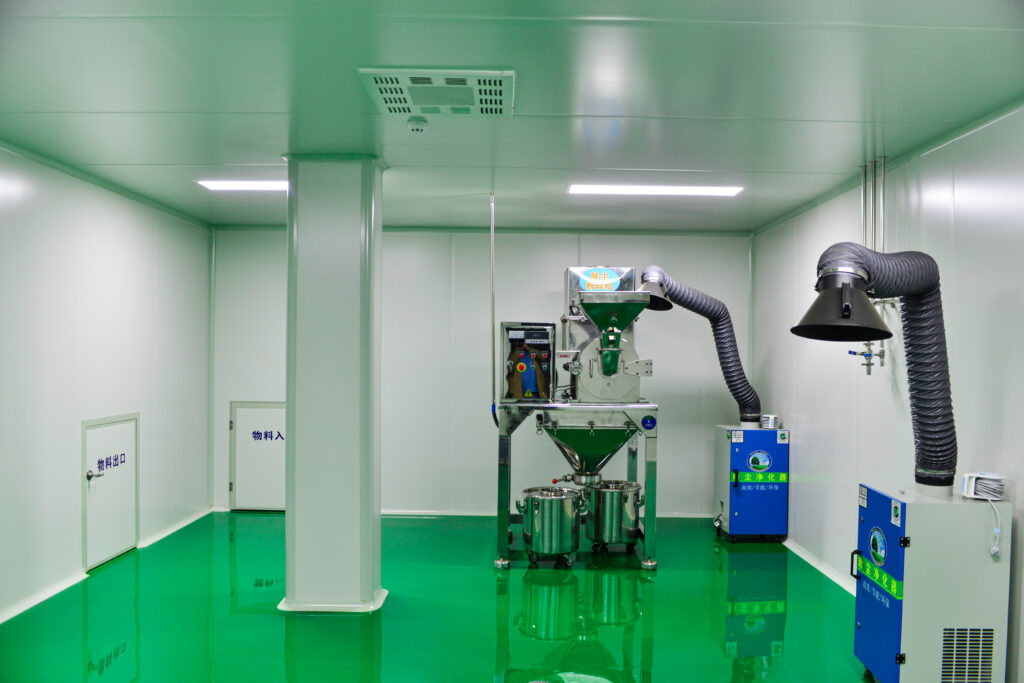
Patented supercritical CO₂ extraction equipment (ZL 202520138144.7) and column chromatography systems (ZL 202520076287.X) enable low-temperature separation of heat-sensitive actives, minimizing solvent residue risks. For high-value ingredients like Glabridin, low-temperature processing is a key parameter for batch stability.
Concentration & Melt Crystallization
The combination of a chromatographic eluate concentrator (ZL 202520262487.4) and a melt crystallizer (ZL 202520076284.6) enables gradient purification from crude extract to high-purity fractions. We currently supply Glabridin in purities ranging from 1% to 99% (HPLC), meeting diverse formulation needs.
Water-Soluble Glabridin Inclusion Complex (Invention Patent)
Licensed invention patent “Water-soluble Glabridin inclusion complex and preparation method thereof” (ZL 202111026952.7) addresses the industry challenge of Glabridin’s poor water solubility. The technology significantly improves dispersibility in water-based and transparent serum formulations.
Intelligent Artemisinin Extraction Tracking (Invention Patent)
“Invention patent for intelligent tracking and recognition method of Artemisinin extraction” (ZL 202511706529.X) demonstrates our exploration of digital process control, optimizing extraction endpoint judgment to improve yield and batch consistency.
3. Product Portfolio: Licorice Series & Star Actives
Licorice Extracts — Sourced from Central Asia
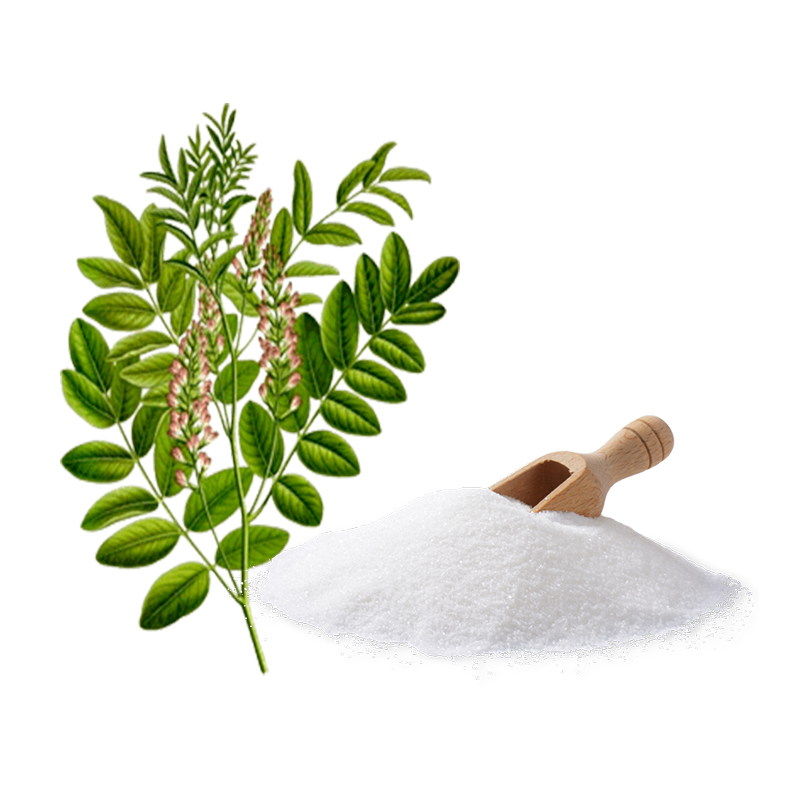
Our Dipotassium Glycyrrhizinate, Monoammonium Glycyrrhizinate, Tripotassium Glycyrrhizinate, and Licorice Antioxidant are sourced from premium licorice grasslands across the Five Stans (Central Asia). By controlling planting environments, harvest seasons, and primary processing standards at the origin, we ensure batch stability and traceability for the entire licorice acid series.
Star Actives — High Purity, Multiple Specifications
Beyond licorice derivatives, our core portfolio includes:
- Glabridin: 1%–99% (HPLC), including oil-soluble 90% grade
- Totarol: 1%–99%
- PDRN-C: Cosmetic-grade polydeoxyribonucleotide
- Beta Glucan (Yeast) 90%: High-purity yeast-derived fraction
- Kojic Acid Dipalmitate: Oil-soluble cosmetic ingredient
- Vitamin K2 (MK-7): For eye-area and mature-skin formulations
All products are accompanied by COA, TDS, and MSDS documentation, supporting clients through R&D to regulatory filing.
4. Supply Chain & Services: Beyond Ingredient Delivery
Food Production License Backing
Through our affiliated production facility, Shaanxi Huafan Bio-fine Chemical Co., Ltd., we hold a Food Production License (SC) covering licorice extract powder, tripotassium glycyrrhizinate, and mono-potassium glycyrrhizinate. For brands operating in both cosmetics and food, this dual qualification provides a compliant foundation for cross-category applications.
Flexible Customization & Technical Support
- Sample requests: Small-batch samples supported for formulation validation
- Custom specifications: Purity, particle size, and solubility profiles adjusted per client requirements
- Formulation guidance: Compatibility and stability recommendations based on TDS data
Frequently Asked Questions
Q: How should a cosmetic brand evaluate a raw material supplier’s certifications?
Direct answer: Prioritize ISO 9001 for quality management, sector-specific certifications (COSMOS/HALAL) for target markets, and food/cosmetic production licenses for compliance scope.
The completeness of a certification portfolio reflects a supplier’s capabilities in quality control, regulatory compliance, and international market access. Shaanxi Huatai Bio-fine Chemical Co., Ltd. holds ISO 9001, ISO 22000, COSMOS, HALAL, and High-Tech Enterprise status, covering dimensions from production management to innovation. For export-oriented brands, we recommend additionally verifying whether target markets impose specific regulatory restrictions on salt forms (e.g., potassium vs. ammonium salts).
Q: What are the selection criteria for a Glabridin supplier?
Direct answer: Evaluate HPLC purity verification, multi-specification availability, water-solubility modification patents, and completeness of COA/TDS documentation.
Glabridin quality is determined by three factors: purity authenticity, batch consistency, and formulation compatibility. We offer Glabridin from 1% to 99% purity, and hold an invention patent for water-soluble inclusion complexes (ZL 202111026952.7), enabling applications across water-based, emulsion, and oil-based systems. We recommend requesting samples for pre-formulation compatibility testing before purchase.
Q: Should I choose Dipotassium Glycyrrhizinate or Monoammonium Glycyrrhizinate for my formulation?
Direct answer: For water-based cosmetic formulations, Dipotassium Glycyrrhizinate (potassium salt) is preferred due to better solubility and thermal stability. Monoammonium Glycyrrhizinate (ammonium salt) may be considered for food-flavoring applications or specific process pathways.
The core difference lies in the counter-ion. Dipotassium Glycyrrhizinate exhibits superior water solubility and temperature stability, making it suitable for water-based skincare. Monoammonium Glycyrrhizinate offers cost advantages in certain food applications. Final selection should be based on formulation type, process temperature, and target market regulations. We supply both ingredients in cosmetic-grade and food-grade specifications, with customization available.
Q: How do I assess the reliability of a Chinese cosmetic raw material manufacturer?
Direct answer: Evaluate four dimensions — certification completeness, patent portfolio, production facility licenses, and technical documentation availability.
A reliable manufacturer should demonstrate: (1) a certification system covering quality management and international market access; (2) proprietary intellectual property reflecting process barriers; (3) food/cosmetic production permits; and (4) complete COA, TDS, and MSDS files. Shaanxi Huatai Bio-fine Chemical Co., Ltd. has established verifiable credentials across all four dimensions. We recommend validating through sample testing and small-batch trials.
Request Samples & Technical Documents
If you are evaluating licorice extracts or star actives for your formulations, please contact Shaanxi Huatai Bio-fine Chemical Co., Ltd.:
- Request free samples: Submit your formulation requirements and estimated usage volumes
- Download TDS/COA: Visit our product pages for the latest technical documentation
- Technical consultation: For compatibility, use levels, or regulatory compliance questions, contact our technical support team
> Technical parameters in this article are based on Huatai Bio TDS and publicly available certification data, provided for formulation R&D reference only. They do not constitute efficacy claims for finished products. For specific applications, please consult our technical support team.
Keywords: cosmetic raw material supplier, licorice extract manufacturer, Glabridin supplier, Dipotassium Glycyrrhizinate manufacturer, ISO 9001 certified, COSMOS certified, HALAL certified, cosmetic ingredient COA, China cosmetic raw material supplier, Huatai Bio, Shaanxi Huatai Bio-fine Chemical
Official website: https://huataibio.com.cn
Author: Mia, Marketing Department, Huatai Bio, specializing in sharing industry news on cosmetic ingredients and food additives.
 陕公网安备61010302001575号