
Dipotassium Glycyrrhizate: Uses, Benefits & Formulation Guide
Quick Answer
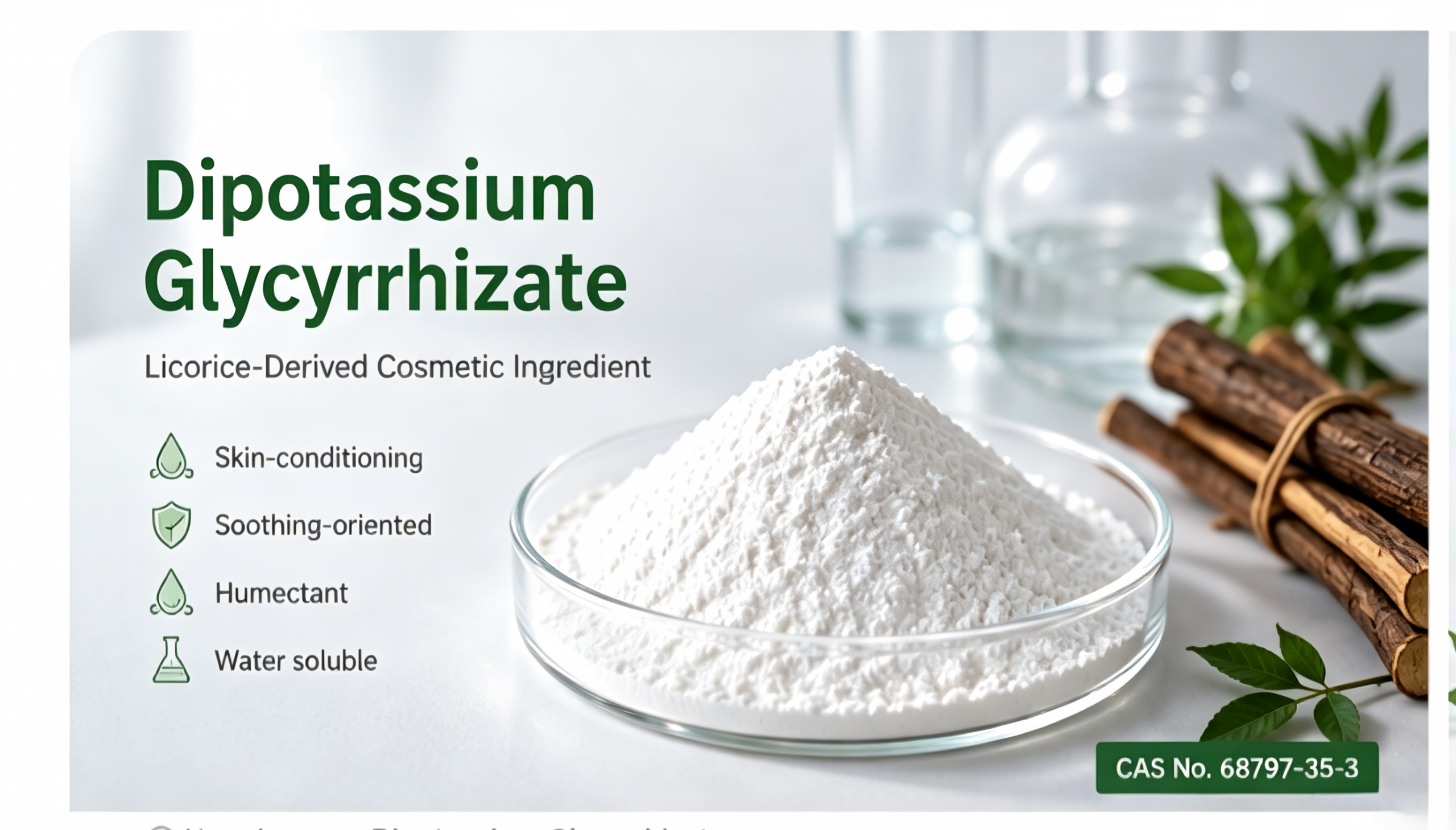
Dipotassium Glycyrrhizate is the dipotassium salt of glycyrrhizic acid, a licorice-derived ingredient used in cosmetic and personal care formulations. It is commonly associated with skin-conditioning and humectant functions and is used in soothing-oriented and sensitive-skin formulations. CAS No. 68797-35-3.
What Is Dipotassium Glycyrrhizate?
Dipotassium Glycyrrhizate is the dipotassium salt of glycyrrhizic acid, a naturally occurring compound associated with licorice (Glycyrrhiza) species. It is used as an ingredient in cosmetic and personal care formulations.
Dipotassium Glycyrrhizate is also known as Dipotassium Glycyrrhizinate or Glycyrrhizic Acid Dipotassium. Its CAS No. is 68797-35-3.
Although it is derived from licorice, Dipotassium Glycyrrhizate should not be treated as synonymous with licorice extract. Licorice extract is a botanical preparation containing multiple constituents, while Dipotassium Glycyrrhizate refers to a defined chemical substance.
This distinction is important for formulators and ingredient buyers because different licorice-derived ingredients can have different chemical identities, specifications, functions and formulation requirements.
Dipotassium Glycyrrhizate at a Glance
| Property | Information |
| Common Name | Dipotassium Glycyrrhizate |
| Alternative Name | Dipotassium Glycyrrhizinate |
| CAS No. | 68797-35-3 |
| EC No. | 272-296-1 |
| Molecular Formula | C₄₂H₆₀K₂O₁₆ |
| Molecular Weight | 899.1 g/mol |
| Botanical Association | Licorice / Glycyrrhiza |
| Appearance | White powder |
| Solubility | Water soluble |
| Recommended Addition | 0.1–5% |
| Huatai Grades | 73% / 75% / UV 98% |
| Shelf Life | 24 months |
What Is Dipotassium Glycyrrhizate Used For?
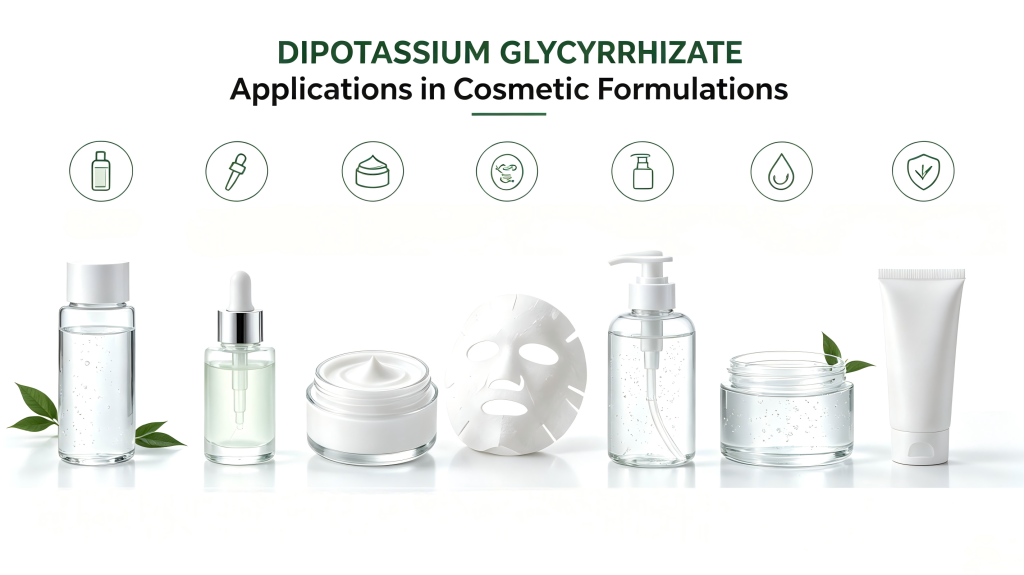
This ingredient is used in cosmetic and personal care formulations primarily for skin-conditioning and humectant functions. It is also commonly incorporated into products designed for soothing-oriented, sensitive-skin and moisturizing applications.
In formulation development, its role should be distinguished from therapeutic claims. The use of Dipotassium Glycyrrhizate in a soothing-oriented cosmetic formulation does not mean that the ingredient or finished product is intended to treat inflammatory or other medical skin conditions.
- Facial toners
- Serums and essences
- Lotions and creams
- Facial masks
- Facial cleansers
- Moisturizing formulations
- Sensitive-skin formulations
- Other personal care products
What Does Scientific Research Say?
Research related to Dipotassium Glycyrrhizate and glycyrrhizic acid includes studies ranging from laboratory investigations to finished-product evaluations. These different types of evidence should not be treated as equivalent when evaluating cosmetic applications.
A human study has evaluated a topical formulation containing Dipotassium Glycyrrhizate together with panthenol and niacinamide in subjects with dry, sensitive skin. Improvements in skin hydration and transepidermal water loss were observed during the study.
However, because the tested formulation contained multiple active ingredients, the results cannot be attributed to Dipotassium Glycyrrhizate alone. The study is therefore more appropriately considered supporting evidence for this type of multi-ingredient formulation rather than direct clinical proof of the effect of Dipotassium Glycyrrhizate as a standalone ingredient.
Evidence Matters in Cosmetic Ingredient Evaluation
When evaluating scientific evidence for a cosmetic ingredient, formulators should distinguish between studies on the ingredient itself, related compounds, finished formulations and supplier-specific product testing. This helps avoid translating preliminary or formulation-specific findings into unsupported ingredient claims.
How Is Dipotassium Glycyrrhizate Used in Cosmetic Formulations?
Dipotassium Glycyrrhizate can be incorporated into a variety of water-based and emulsion-based cosmetic formulations. Huatai’s current commercial grades are listed as water soluble, making solubility an important consideration when determining the appropriate incorporation process.
Huatai’s current product information recommends an addition level of 0.1–5%, depending on the selected grade, formulation and intended application.
The 0.1–5% range is a Huatai product recommendation rather than a universal regulatory limit. The final use level should be determined according to formulation requirements, finished-product safety assessment and applicable regulations in the target market.
Dipotassium Glycyrrhizate Commercial Grades
Huatai Bio currently offers Dipotassium Glycyrrhizate in three commercial grades: 73%, 75% and UV 98%. All three grades are supplied as white powders and are listed as water soluble in Huatai’s current product information.
The appropriate grade should be selected according to the formulation requirements, target specification and analytical requirements of the finished product.
| Grade | Appearance | Solubility | Recommended Addition | Shelf Life |
| 73% | White powder | Water soluble | 0.1–5% | 24 months |
| 75% | White powder | Water soluble | 0.1–5% | 24 months |
| UV 98% | White powder | Water soluble | 0.1–5% | 24 months |
Note: Grade designations and specifications should always be confirmed against the applicable product specification and batch COA. Contact Huatai Bio for the latest technical documentation before formulation or commercial purchasing.
Need the latest specification or COA? Contact Huatai Bio to request technical documentation or a product sample.
How to Choose the Right Dipotassium Glycyrrhizate Grade
Choosing the appropriate grade should be based on the requirements of the formulation rather than the percentage designation alone. Buyers should first confirm what the grade designation represents, which analytical method is used and whether the specification matches their formulation and quality requirements.
Confirm the Grade and Assay Method
Percentage values from different suppliers should not be compared without checking the corresponding specification and analytical method. A higher numerical value does not by itself provide enough information to determine whether one grade is more suitable for a particular formulation.
Check Solubility and Formulation Compatibility
Solubility affects how a raw material is incorporated into a formulation. Huatai’s current grades are listed as water soluble, but formulators should still evaluate the selected grade in their actual formulation system.
Review Quality Specifications
Review the relevant specification and COA for parameters such as assay, appearance and other quality-control requirements applicable to the selected grade.
Evaluate the Intended Application
The final grade and use level should be selected according to the intended product, formulation system, target market and finished-product requirements.
What Should Buyers Check in a Dipotassium Glycyrrhizate Specification?
When sourcing Dipotassium Glycyrrhizate for commercial formulation, buyers should evaluate both the material specification and the supplier’s quality documentation. Price alone is not sufficient for comparing different commercial grades.
| Buyer Question | What to Check |
| What grade is being offered? | Grade designation and specification |
| What does the percentage represent? | Assay definition and analytical method |
| Is it suitable for the formulation? | Solubility and formulation compatibility |
| Is quality consistent? | Batch-to-batch COA |
| What quality parameters are controlled? | Product specification |
| Are technical documents available? | COA, SDS, TDS or specification |
| Can the material be tested first? | Sample availability |
| Can the supplier support commercial purchasing? | Documentation and batch consistency |
For botanical-derived raw materials, buyers should also review relevant quality-control information for contaminants and other parameters required by their target market or internal quality standards.
Dipotassium Glycyrrhizate vs. Glycyrrhizin
Dipotassium Glycyrrhizate and glycyrrhizin are related, but the terms should not be used interchangeably when specifying a commercial raw material.
Glycyrrhizin, also known as glycyrrhizic acid, is a major triterpenoid saponin associated with licorice. Dipotassium Glycyrrhizate is the dipotassium salt of glycyrrhizic acid.
For formulation and purchasing purposes, the exact chemical form matters because specifications, analytical methods, solubility and other technical characteristics may differ. Buyers should therefore confirm the actual substance and grade rather than relying on the general term “glycyrrhizin.”
Dipotassium Glycyrrhizate vs. Licorice Extract
Dipotassium Glycyrrhizate is not the same as licorice extract.
Licorice extract is a botanical preparation that may contain multiple naturally occurring constituents from Glycyrrhiza species. Dipotassium Glycyrrhizate, by contrast, refers to a defined salt of glycyrrhizic acid.
This distinction is important when comparing ingredients for formulation development. A licorice extract should not automatically be assumed to have the same composition, specification or formulation characteristics as Dipotassium Glycyrrhizate.
Dipotassium Glycyrrhizate vs. Glabridin
Dipotassium Glycyrrhizate and Glabridin are both associated with licorice, but they are chemically different ingredients and should not be treated as substitutes based solely on their botanical origin.
| Comparison | Dipotassium Glycyrrhizate | Glabridin |
| Ingredient type | Glycyrrhizic acid salt | Licorice-derived flavonoid |
| Botanical association | Licorice | Licorice |
| Typical formulation positioning | Skin conditioning / soothing-oriented care | Brightening / tone-evening-oriented care |
| Same ingredient? | No | No |
Ingredient selection should therefore be based on the intended formulation objective, specification and supporting technical data rather than botanical origin alone.
Is Dipotassium Glycyrrhizate Safe for Cosmetic Use?
Dipotassium Glycyrrhizate has been evaluated by the Cosmetic Ingredient Review (CIR) as part of its safety assessment of glycyrrhetinic acid, glycyrrhizic acid and related derivatives.
The CIR assessment concluded that the reviewed ingredients, including Dipotassium Glycyrrhizate, were safe for use in cosmetics under the conditions evaluated.
Historical concentration data included Dipotassium Glycyrrhizate use at concentrations up to 1% in the information evaluated by CIR. This should not be interpreted as a universal regulatory maximum of 1% for every country, formulation or product category.
Finished-product safety remains dependent on the formulation, concentration, exposure conditions, intended use and applicable requirements in the target market.
Huatai Dipotassium Glycyrrhizate
Shaanxi Huatai Bio-Fine Chemical Co., Ltd. supplies Dipotassium Glycyrrhizate and other licorice-derived ingredients for cosmetic and personal care applications.
Huatai’s current Dipotassium Glycyrrhizate portfolio includes 73%, 75% and UV 98% grades. The listed grades are white powders, are described as water soluble and have a listed shelf life of 24 months under the specified storage conditions.
For B2B evaluation, customers can request the relevant product specification and available technical documentation before sample testing or commercial purchasing.
| Product Information | Huatai |
| Available Grades | 73% / 75% / UV 98% |
| Appearance | White powder |
| Solubility | Water soluble |
| Recommended Addition | 0.1–5% |
| Shelf Life | 24 months |
| Technical Documents | Available upon request |
| Sample | Available upon request |
Huatai Product Research
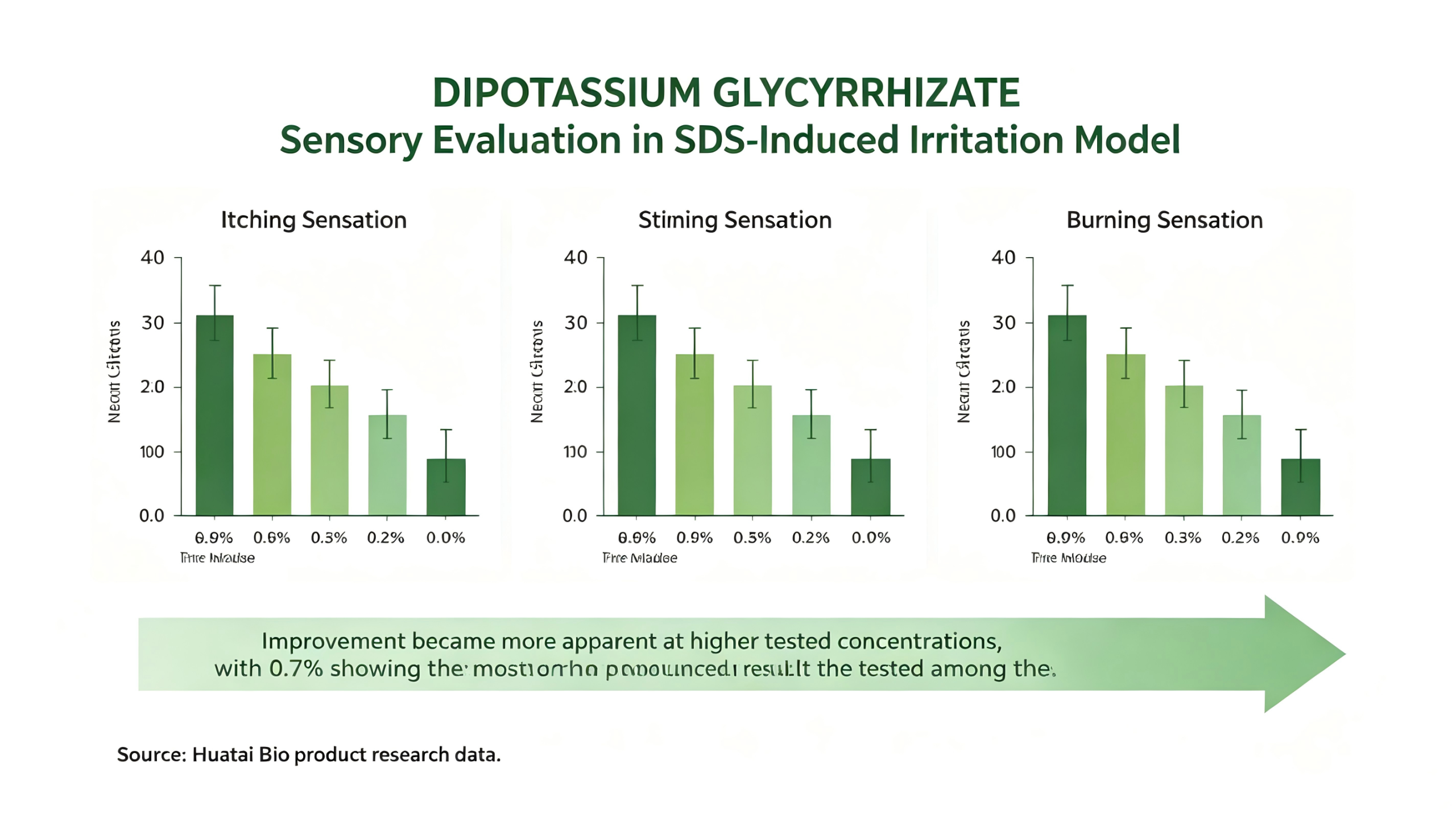
Huatai’s product materials include sensory evaluation data examining Dipotassium Glycyrrhizate in an SDS-induced skin irritation model.
The reported evaluation compared perceived itching, stinging and burning sensations after the application of different concentrations of Dipotassium Glycyrrhizate. In the data presented, improvement generally became more apparent at higher tested concentrations, with 0.7% showing the most pronounced result among the tested concentrations.
These results are presented as Huatai product research data. They should not be interpreted as evidence that Dipotassium Glycyrrhizate treats or prevents a medical skin condition, and results from this test should not automatically be generalized to every finished formulation.
Frequently Asked Questions
What is Dipotassium Glycyrrhizate?
Dipotassium Glycyrrhizate is the dipotassium salt of glycyrrhizic acid, a compound associated with licorice. It is used in cosmetic and personal care formulations.
What is the CAS number of Dipotassium Glycyrrhizate?
The CAS number of Dipotassium Glycyrrhizate is 68797-35-3.
Is Dipotassium Glycyrrhizate the same as Dipotassium Glycyrrhizinate?
Dipotassium Glycyrrhizate and Dipotassium Glycyrrhizinate are commonly used names referring to the same chemical substance.
What is Dipotassium Glycyrrhizate used for?
It is used in cosmetic and personal care formulations for skin-conditioning and humectant functions and is commonly incorporated into soothing-oriented and sensitive-skin formulations.
Is Dipotassium Glycyrrhizate water soluble?
Huatai’s current 73%, 75% and UV 98% commercial grades are listed as water soluble.
What is the recommended addition level?
Huatai’s current product information recommends 0.1–5%, depending on the grade, formulation and intended application. This is a supplier recommendation rather than a universal regulatory limit.
What grades of Dipotassium Glycyrrhizate does Huatai offer?
Huatai currently offers 73%, 75% and UV 98% grades.
Is Dipotassium Glycyrrhizate the same as licorice extract?
No. Licorice extract is a botanical preparation containing multiple constituents, while Dipotassium Glycyrrhizate refers to a defined salt of glycyrrhizic acid.
Is Dipotassium Glycyrrhizate the same as Glabridin?
No. Both are associated with licorice, but they are chemically different ingredients with different specifications and typical formulation applications.
How can I request a sample or technical documents?
Contact Huatai Bio with your intended application and required grade to request available product specifications, technical documentation or a sample.
Looking for Dipotassium Glycyrrhizate?
Evaluate Huatai’s 73%, 75% and UV 98% grades for your formulation and application requirements.
References
- PubChem — Dipotassium Glycyrrhizinate / Dipotassium Glycyrrhizate
- U.S. FDA Global Substance Registration System (GSRS) — Glycyrrhizinate Dipotassium
- Cosmetic Ingredient Review — Safety Assessment of Glycyrrhetinic Acid, Glycyrrhizic Acid and Related Derivatives
- Peer-reviewed human research on a formulation containing Dipotassium Glycyrrhizate, niacinamide and panthenol
- Huatai Bio — Dipotassium Glycyrrhizate Product Technical Information
- Huatai Bio — Product Research Data
About the Author
Mia | Marketing Department, Shaanxi Huatai Bio-Fine Chemical Co., Ltd.
Focused on cosmetic ingredients, plant-derived actives and B2B ingredient content, with an emphasis on translating product specifications, scientific evidence and application information into practical resources for formulators and ingredient buyers.
 陕公网安备61010302001575号